
LinkedIn Patches #21 Answer
Stuck on today’s grid? Get the LinkedIn Patches #21 solution and expert logic to maintain your streak instantly. Beyond the answer, explore our tactical hints to refine your spatial reasoning and master the game through daily practice.
Patches #21 Answer
Start
Answer
Patches #21 Expert Logic
🧩 Deep Logic Analysis
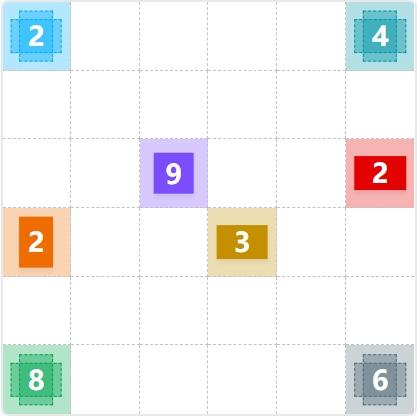
Solving Patches #21 requires a "big-to-small" strategy. The grid is a 6x6 space (36 total cells), and the sum of all clues () equals exactly 36. This means there is zero wasted space; every cell must be claimed by a patch.
The Anchor: The Purple 9
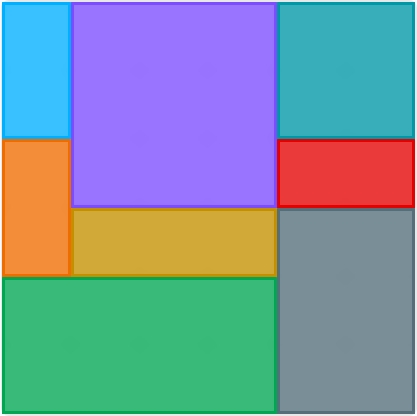
The Purple 9 features a square icon, indicating its shape. In a 6x6 grid, a 9-cell square must be 3x3. Its central placement is the primary constraint. Once you place the 3x3 Purple square in the top-center, it dictates the boundaries for the top-left, top-right, and center-left patches.
The Corner Constraints
With the Purple 9 occupying the top-middle, the Light Blue 2 in the top-left corner is forced into a 1x2 vertical orientation. Similarly, the Teal 4 (marked with a square icon) must be a 2x2 block in the top-right corner. This "corner-pinning" is a essential practice for high-level players.
The Chain Reaction
- Placing the Teal 4 and Purple 9 leaves a 2x1 gap on the right edge. The Red 2 (horizontal icon) fits perfectly here.
- On the left, the Orange 2 (vertical icon) is forced into the remaining 1x2 slot beneath the Light Blue patch.
- The Gold 3 (horizontal icon) must sit directly beneath the Purple 9. Since the Purple 9 is 3 cells wide, the Gold 3 fits perfectly as a 3x1 strip.
- Finally, the bottom 14 cells are split between the Green 8 and Grey 6. The Green 8 takes a 4x2 horizontal block to clear the bottom-left, leaving a 2x3 vertical block for the Grey 6.
🎓 Lessons Learned From Patches #21
1. The "Zero-Waste" Principle
Whenever the sum of the clues equals the total area of the grid, you know that shapes cannot overlap and no cells can remain empty. This allows you to use the "process of elimination" more aggressively—if a shape could go in two places but one leaves an isolated single cell, that placement is mathematically impossible.
2. Icon Orientation is Law
The background icons (Square, Vertical Rectangle, Horizontal Rectangle) are not just aesthetic; they are rigid constraints. In this puzzle, the three different "2" patches (Blue, Orange, Red) were differentiated entirely by their icons. Ignoring these icons leads to unsolvable "dead ends" in the logic chain.
💡 Trivia
The Magic Square Connection
The central clue in this puzzle is a 9, which is the highest single-digit square number. In recreational mathematics, 9 is also the magic constant of a 3x3 magic square if you use the numbers 1-9 (the sum is 15, but the central number is always 5). Here, the 9 acts as the "gravitational center" of the puzzle.
Perfect Packing
This specific grid is an example of "Tiling a Rectangle with Polyominoes." While most Patches puzzles use simple rectangles, the logic used to solve them is a foundational concept in computational geometry used in everything from microchip design to warehouse logistics.
❓ FAQ
Why couldn't the Green 8 be a 2x4 vertical block?
The icon for the Green 8 is a horizontal rectangle, and the available width at the bottom of the grid allows for a 4-cell wide placement. Moving it vertically would collide with the Gold 3 and Orange 2 patches, breaking the "no overlap" rule.
How do I know the Purple 9 isn't a 1x9 strip?
The 6x6 grid dimensions physically limit any straight line to a maximum of 6 cells. Furthermore, the square icon behind the number 9 explicitly dictates that the patch must maintain an equal height and width, making 3x3 the only viable geometry.
What is the best way to start a puzzle like this?
Always look for the largest numbers and the most restrictive icons first. The Purple 9 and Green 8 occupy nearly half the board combined. By placing these "anchors" first, the smaller shapes like the 2s and 3s are forced into their only logical positions.