
LinkedIn Patches #52 Answer
Stuck on today’s grid? Get the LinkedIn Patches #52 solution and expert logic to maintain your streak instantly. Beyond the answer, explore our tactical hints to refine your spatial reasoning and master the game through daily practice.
Patches #52 Answer
Start
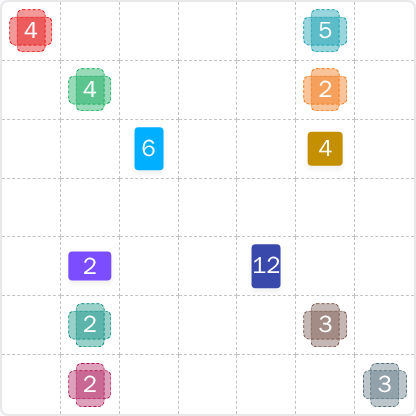
Answer
Patches #52 Expert Logic
Here is your expert analysis of the provided LinkedIn Patches puzzle.
🧩 Deep Logic Analysis
This grid was a fantastic exercise in using constraints to create a cascade of solutions. The key was identifying the most restricted shapes first and letting them dictate the flow. With a little practice, this kind of deductive reasoning becomes second nature.
Here’s a step-by-step breakdown of the solve path:
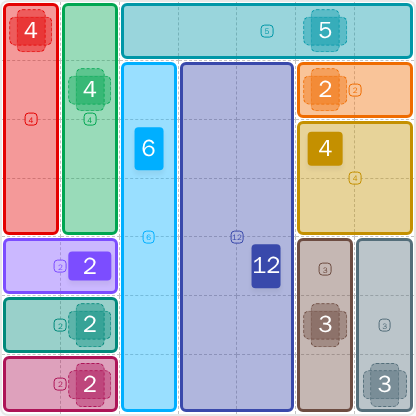
- The Prime Suspects: The most powerful starting points in any Patches grid are the prime-numbered areas. The Cyan 5 and the two Gray 3s can only be 1x5 and 1x3 strips, respectively. The Cyan 5, tucked in the top-right corner, could only be a 1x5 horizontal piece; placing it vertically as a 5x1 would immediately conflict with the Orange 2 and Gold 4 clues. This single placement sets the entire top-right quadrant in motion.
- Corner Pocket: With the Cyan 5 solved, we look to the other corner. The Red 4 in the top-left had two options: a 2x2 square or a 1x4 strip. Placing it as a 2x2 square would isolate the Green 4's clue, making it impossible to form a valid shape. Therefore, the Red 4 must be a 1x4 vertical strip.
- The First Chain Reaction: The placement of the vertical Red 4 now perfectly defines the space for the Green 4. It's boxed in, forcing it to be a 2x2 square. This, in turn, provides a hard upper boundary for the Light Blue 6, which neatly forms a 2x3 rectangle underneath it.
- The Central Keystone: The Dark Blue 12 is the largest piece and the logical lynchpin. With shapes forming on all sides, its options dwindled. It couldn't be a 2x6 or a 1x12. The only configuration that fit the rapidly shrinking central space was a 3x4 vertical rectangle. This move was the decisive one, splitting the board and defining the boundaries for all remaining pieces.
- Falling Dominos: With the large central shapes locked in, the rest was a matter of fitting the remaining pieces into their clearly defined pockets. The Gold 4 became a 2x2, the Gray 3s became 1x3 strips, and the trio of 2-area shapes (Purple, Teal, Pink) filled the remaining slots on the left.
🎓 Lessons Learned From This Grid
- The Prime Directive: Always identify and place prime-numbered shapes first (2, 3, 5, 7, etc.). Their 1xN dimensions eliminate rotational ambiguity and provide rigid boundaries that other, more flexible shapes must conform to.
- Square Up: For areas that can be a square (4, 9, 16), always test that possibility. A square is a powerful constraint. In this puzzle, deducing that the Green 4 and Gold 4 had to be 2x2 squares was critical to solving the areas around them.
- Embrace the Void: Unlike puzzles that require tiling the entire board, Patches uses empty space as a crucial strategic element. The 15 empty cells here weren't an afterthought; they were essential for creating the unique pathways and boundaries that made the solution possible.
💡 Trivia
- The Power of Twelve: The number 12 is a "highly composite number," having more divisors (1, 2, 3, 4, 6, 12) than any smaller integer. This mathematical property is why it shows up so often in history (12 months, 12 inches, 12 zodiac signs) and why the "12" piece in this puzzle had the most potential shapes (1x12, 2x6, 3x4).
- A Modern Pentomino: Patches is a modern digital variation of a classic genre of mathematics known as "tiling puzzles." The most famous of these is the "pentomino" puzzle, which challenges you to tile a rectangular box with 12 unique shapes made from five squares each.
❓ FAQ
Why couldn't the Dark Blue 12 piece be a 2x6 rectangle?
A 2x6 rectangle for the Dark Blue 12 was impossible due to the surrounding clues. If placed horizontally, a 6-unit-wide shape would have collided with the clues for the Light Blue 6 on the left and the Gold 4 on the right. If placed vertically, a 6-unit-tall shape would have extended too far down, conflicting with the lower Gray 3 clue. The solved shapes around it created a container that only a 3x4 rectangle could fit inside.
How did you know the Red 4 in the corner had to be a 1x4 strip and not a 2x2 square?
This was a critical early deduction. If the Red 4 had been a 2x2 square in the top-left corner, it would have created a 1-cell-wide column between itself and the Green 4's clue. Since all shapes must be at least one cell wide and must contain their clue, it would have been impossible for the Green shape to reach its clue two cells away. Placing the Red 4 as a 1x4 vertical strip was the only way to leave enough room for the Green shape to form.
What is the purpose of the empty white cells?
The empty cells are a core feature of the Patches puzzle. Unlike some tiling puzzles where every single square must be filled, Patches requires you only to place the given shapes correctly. The empty space acts as a boundary, helping to define where shapes cannot go. Learning to use the void as a strategic tool is just as important as figuring out where the pieces go.