
LinkedIn Patches #53 Answer
Stuck on today’s grid? Get the LinkedIn Patches #53 solution and expert logic to maintain your streak instantly. Beyond the answer, explore our tactical hints to refine your spatial reasoning and master the game through daily practice.
Patches #53 Answer
Start
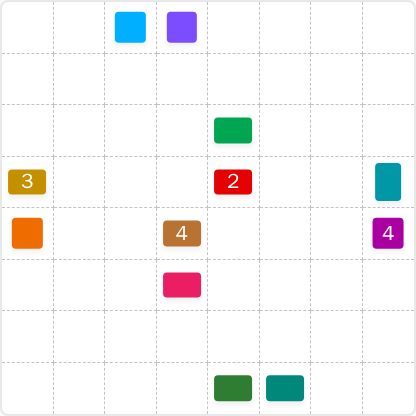
Answer
Patches #53 Expert Logic
Here is the strategic breakdown and logical analysis for LinkedIn Patches #53.
🧩 Deep Logic Analysis
To conquer Patches #53, we have to rely on spatial deduction rather than guessing. Here is the step-by-step deconstruction of how this board unravels.
The Starting Points: Prime Anchors The best entry points in this grid are the prime numbers: the Mustard 3 and the Red 2. Prime numbers are mathematically rigid because they can only form 1xN strips.
- Look at the Mustard 3 on the left. If it were a vertical 3x1 strip, it would ruin the corner logic for the Light Blue and Orange shapes, leaving unfillable gaps. Therefore, it must be a horizontal 1x3 strip.
- The same logic applies to the Red 2 in the center—it is forced to be a horizontal 1x2 rectangle to avoid blocking the vertical growth of the shapes above and below it.
The Chain Reaction
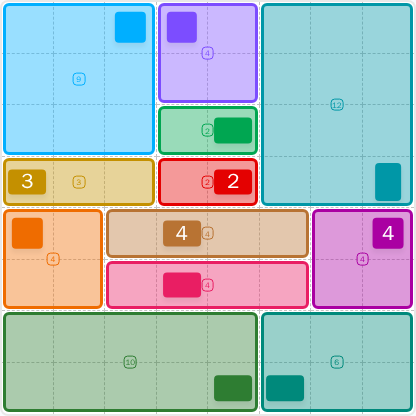
- Top-Left Lock: Once the Mustard 3 is placed horizontally, it creates a flat floor for the Light Blue shape. Trapped by the top-left corner, the Light Blue shape perfectly resolves into a 3x3 square.
- Top-Right Domination: With Light Blue taking up the top-left, the Purple block is nudged into the center-top as a 2x2. The right side is bounded by the Magenta 4 (which forms a 2x2 square). This traps the top-right Teal shape into the remaining void, forcing it to become a massive 3x4 rectangle (Area 12).
- The Bottom Sweep: Look at the bottom left. The Orange shape forms a 2x2 above it. This forces the Dark Green shape to stretch all the way across the bottom left to claim the corner, resolving into a long 2x5 strip.
- The Middle Squeeze: With the top and bottom borders locked in, the center of the board is squeezed tight. The Brown 4 and Pink shapes have nowhere to go but sideways, naturally forming two stacked 1x4 horizontal strips.
🎓 Lessons Learned From Patches #53
- The Prime Number Strategy: Clues with prime numbers (2, 3, 5, 7) are your strongest anchors. Because their dimensions cannot be factored into anything other than 1xN, they heavily restrict the board early on. Find them, orient them, and use them as your foundation.
- The Squeeze Play: Blank shapes (like the Pink and Brown rectangles) are highly ambiguous at the start of the puzzle. Wait to solve them. By resolving the rigid corners and edges first, you "squeeze" the center of the board, forcing ambiguous shapes into their only remaining geometric configurations. Regular practice with this inside-out method will dramatically decrease your solve times.
💡 Trivia
- The Mathematical Anchor: Did you know that prime numbers act as the ultimate puzzle stabilizers? Because a number like 12 can be a 1x12, 2x6, or 3x4 rectangle, highly composite numbers create multiple branches of logic. Prime numbers, however, have only two permutations (horizontal or vertical), making them the mathematical keys to grid-partition puzzles.
- Perfect Partitioning: An 8x8 grid contains exactly 64 squares. The 12 uniquely colored shapes in this specific puzzle mathematically partition those 64 squares with zero overlap and zero wasted space—a concept in discrete geometry known as "perfect orthogonal tiling."
❓ FAQ
Why couldn't the Mustard 3 be a vertical 3x1 rectangle?
If it were a vertical strip, it would fracture the left edge of the board. The Light Blue shape above it would be unable to form a clean, symmetrical rectangle into the top-left corner, leaving orphaned squares that no other shape could legally claim.
How do we know the exact size of the top-right Teal shape?
It relies on a process of elimination. Once the Purple 2x2 is locked in at the top and the Magenta 4 resolves as a 2x2 on the right edge, the remaining void in the top-right is a perfect 12-square grid. The Teal clue is the only shape available to absorb this entire 3x4 area.
Should I prioritize numbered clues or blank colored squares?
Always prioritize numbered clues—especially prime numbers. Blank shapes are highly flexible and dangerous to guess on early. Numbered shapes have mathematical constraints that will quickly "box in" the blank shapes for you.