
LinkedIn Patches #27 Answer
Stuck on today’s grid? Get the LinkedIn Patches #27 solution and expert logic to maintain your streak instantly. Beyond the answer, explore our tactical hints to refine your spatial reasoning and master the game through daily practice.
Patches #27 Answer
Start
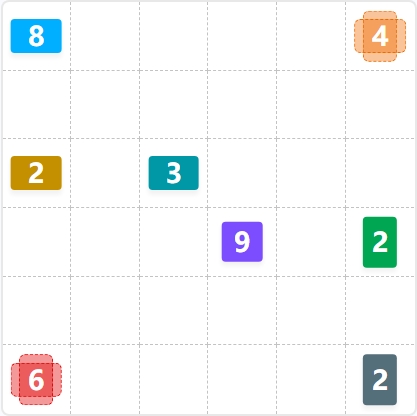
Answer

Patches #27 Expert Logic
🧩 Deep Logic Analysis
The beauty of Patches #27 lies in its centralized constraints. While many players instinctually gravitate toward the corners, the key to this grid is the interplay between the largest area (the Purple 9) and the restricted perimeter.
1. The Square Anchors In this puzzle, the Orange 4 and Purple 9 act as your anchors. The Orange 4, indicated by the cross-hair dashed border, is restricted to a square in the top-right corner. Simultaneously, the Purple 9 is a mathematical lock; a square is the only way to fit a 9-patch into a grid without obstructing every other clue. Placing the Purple 9 in the bottom-center is the only logical starting point that allows space for the vertical shapes on the right.
2. The Top-Down Chain Reaction With the Orange 4 occupying a block, the Blue 8 in the top-left is forced into a horizontal rectangle. Any other configuration (like an or a vertical ) would either exceed the grid boundaries or collide with the Gold 2.
3. Solving the Left Flank The Red 6 in the bottom-left corner is constrained by the Purple 9 to its right. This forces it into a vertical orientation. This placement leaves a small gap between the Blue 8 and the Red 6, which perfectly accommodates the Gold 2, completing the entire left side of the board.
4. The Final Column Once the Teal 3 is placed as a horizontal strip (nestled between the Gold 2 and the right edge), only a vertical corridor remains on the far right. This space is mathematically split between the Green 2 and the Grey 2, both resolving as vertical rectangles.
🎓 Lessons Learned From Patches #27
- The "Largest First" Rule: In puzzles involving squares, always attempt to place the largest area clue (the Purple 9) first. Large patches significantly reduce the "possibility space" for smaller, more flexible clues like the 2s and 3s.
- The Remainder Method: If you aren't sure where a shape goes, look at the empty cells left behind. In this grid, the gap on the right edge was a "logic vacuum" that could only be filled by the two remaining 2-patches.
- Consistent Practice: To truly master spatial puzzles, you must practice recognizing how certain dimensions (like vs. ) interact with corner placements.
💡 Trivia
- The Perfect Number: The Red 6 is a "Perfect Number" in mathematics, meaning the sum of its proper divisors () equals the number itself. It is the smallest perfect number and the only one that is also a primorial.
- Square Logic: The Purple 9 represents a "gnomon" growth pattern. In geometry, adding a and a strip to a square is how you "grow" into the next perfect square ().
❓ FAQ
Why couldn't the Blue 8 be a vertical rectangle?
If the Blue 8 were oriented vertically (), it would extend into the 4th row, completely overlapping the space required for the Red 6 and the Gold 2.
How do we know the Orange 4 must be a square?
The dashed cross-hair icon in the unsolved grid is a specific hint indicating that the patch must have equal sides. In Patches, this "Square Constraint" is a vital shortcut for solving corners.
Could the Teal 3 have been a vertical strip?
No. If the Teal 3 were vertical, it would break the "no overlap" rule by cutting through the territory reserved for the Purple 9 square.