
LinkedIn Patches #28 Answer
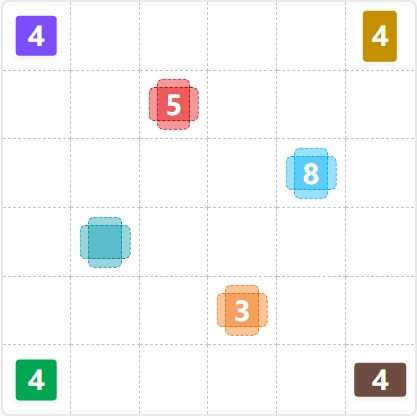
Stuck on today’s grid? Get the LinkedIn Patches #28 solution and expert logic to maintain your streak instantly. Beyond the answer, explore our tactical hints to refine your spatial reasoning and master the game through daily practice.
Patches #28 Answer
Start
Answer
Patches #28 Expert Logic
🧩 Deep Logic Analysis
Solving Patches #28 requires a keen eye for how prime numbers and even-odd constraints interact within a confined grid. The solution relies on a "west-to-east" logic flow, where the left-hand column density dictates the remaining geometry.
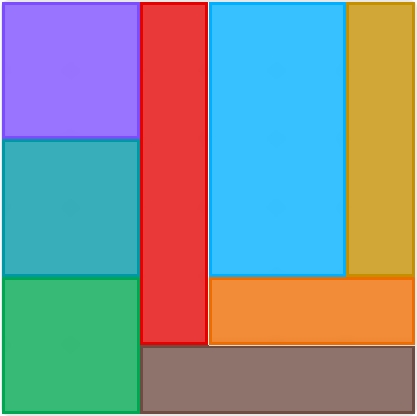
1. The Left-Side "Stack" (The Anchor) The most efficient starting point is the left edge. We have three clues with the value of 4: Purple 4, Teal 4, and Green 4. In a grid, the two leftmost columns represent 12 total cells (). Since , these three clues perfectly tile the first two columns as three squares. This immediate "lock" creates a hard vertical boundary at column 3.
2. The Prime Constraints (Red 5 and Orange 3) With columns 1 and 2 filled, the Red 5 is pushed into a vertical orientation. A horizontal is impossible because it would need to cross into the already occupied Teal/Green territory. Thus, the Red 5 must be a pillar. Similarly, the Orange 3 at the bottom is restricted by the Red pillar and the right wall, forcing it into a horizontal strip in row 5.
3. The Bottom Perimeter (Brown 4) The Brown 4 in the bottom-right corner is trapped. The Green 4 has taken the bottom-left corner, and the Red 5 pillar occupies the cell at (Row 6, Col 3). This leaves exactly four cells remaining in the bottom row (Col 3-6). The Brown 4 must occupy this space.
4. The Final Puzzle Pieces The remaining area in the top right is a block. We have the Light Blue 8 and Gold 4. If Gold 4 were a square, it would leave a fragmented shape for the 8. However, by stretching the Gold 4 into a vertical column on the far right, it leaves a perfect rectangle for the Light Blue 8.
🎓 Lessons Learned From Patches #28
- The Tiling Efficiency Rule: When you see a column or row where the clue values sum exactly to the dimension of that area (e.g., three 4s filling a space), those shapes are almost certainly congruent squares or rectangles that "tile" the space perfectly.
- Edge-In Logic: Always solve the most restricted area first. In this grid, the left edge was more restricted than the right because of the three stacked clues. Dedicating time to practice identifying these high-density zones will significantly speed up your solve time.
💡 Trivia
- The Power of 4: In this specific grid, the number 4 appears five times. Geometrically, 4 is a "composite" number, allowing it to take the form of a square, a strip, or a strip. This grid utilizes all three variations!
- Prime Rigidity: Numbers like 3 and 5 are known as "rigid" clues in Patches logic. Because they only have two factors (1 and themselves), they can only ever be straight lines, making them the best indicators of grid flow.
❓ FAQ
Why couldn't the Light Blue 8 be a 4x2 horizontal rectangle?
A horizontal orientation would require four columns of width. Since the Red 5 pillar and the Gold 4 column occupy specific vertical lanes, there isn't enough contiguous horizontal width to accommodate an 8-cell shape without overlapping another clue.
How do we know the Brown 4 is a 4x1 strip instead of a 2x2 square?
If the Brown 4 were a square in the bottom right corner, it would occupy cells in row 5 and row 6. This would collide with the Orange 3, which is forced into row 5 by the Red 5 pillar. The only way to satisfy both the Orange 3 and the Brown 4 is to stack them as horizontal strips.
Is it possible for the Red 5 to be at the very bottom of the column?
No. If the Red 5 occupied the very bottom cell (Row 6, Col 3), it would break the Brown 4’s only possible path. By ending the Red 5 at Row 5, it allows the Brown 4 to utilize the entire width of the bottom row to satisfy its area requirement.