
LinkedIn Patches #34 Answer
Stuck on today’s grid? Get the LinkedIn Patches #34 solution and expert logic to maintain your streak instantly. Beyond the answer, explore our tactical hints to refine your spatial reasoning and master the game through daily practice.
Patches #34 Answer
Start
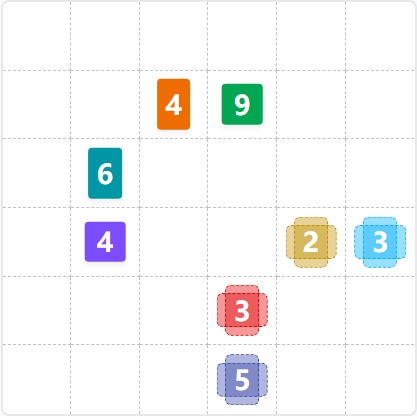
Answer
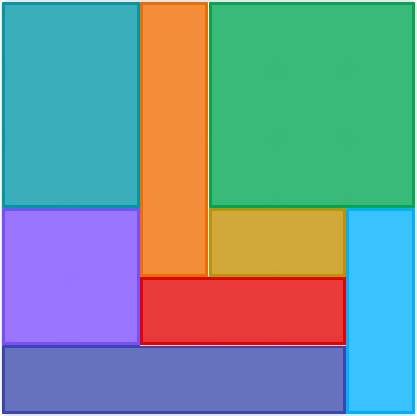
Patches #34 Expert Logic
🧩 Deep Logic Analysis
Solving Patches #34 requires a blend of spatial reasoning and elimination. In a grid (36 total units), every cell must be accounted for by the given clues. Here is the logical breakdown of how to solve this grid:
-
The Anchor Points (Squares & Extremes):
We begin with the Green 9. In a grid, a patch of 9 must be a square, as is physically impossible. Its position in the upper-right quadrant forces it into the corner to avoid blocking too many other paths. Similarly, the Purple 4 is labeled as a square; its placement in the lower-left allows it to sit perfectly as a block. -
The Perimeter Constraints:
The Teal 6 is positioned in the top-left. To satisfy its area without overlapping the Green 9 or the Orange 4, it must manifest as a vertical rectangle. This placement is a vital part of your daily practice in recognizing how corner clues dictate the "flow" of the interior. -
The Vertical "Spine":
With the Teal 6 and Purple 4 occupying the leftmost two columns, the Orange 4 is squeezed. It cannot be a square because the labels designate it as a tall rectangle. Thus, it occupies a vertical strip, bridging the gap between the top border and the bottom sections. -
The Bottom Row Chain Reaction:
The Dark Blue 5 is a prime number, meaning it must be a or strip. Given the layout, it stretches horizontally across the bottom. This leaves a small chimney on the far right, which is the only logical home for the Light Blue 3. -
Finalizing the Core:
The remaining 5 units in the center-bottom are split between the Tan 2 () and the Red 3 (). The Tan 2 must sit above the Red 3 to accommodate the boundaries created by the Orange 4 and the Green 9.
🎓 Lessons Learned From Patches #34
- The Prime Constraint: Numbers like 3 and 5 are "inflexible." In a grid this size, they almost always manifest as strips. Identifying these early prevents you from attempting to "bend" shapes that must remain straight.
- The Squeeze Play: When two large shapes (like the Green 9 and Teal 6) are placed, the "negative space" between them often dictates the dimensions of the smaller shapes. Always look at the gaps left behind rather than just the clues themselves.
💡 Trivia
- Perfect Squares: The Green 9 and Purple 4 are the only "Perfect Squares" in this puzzle. In tiling theory, a square that can be tiled with smaller, unequal squares is called a "Perfect Squared Square." While these aren't all unequal, the logic remains a staple of recreational mathematics.
- The Harmony: A grid is the smallest "highly composite" square grid, meaning 36 has many divisors (). This is why Patches puzzles of this size feel so interconnected—there are dozens of ways to divide the area, but only one that fits the labels.
❓ FAQ
Why couldn't the Teal 6 be a horizontal rectangle?
If the Teal 6 extended three units to the right, it would overlap with the required column for the Orange 4 or force the Green 9 out of its corner, breaking the logic for the entire top row.
Is there any other possible configuration for the Dark Blue 5?
No. Because the Light Blue 3 must be a vertical to fit the remaining far-right edge, the Dark Blue 5 is forced into a horizontal orientation along the bottom-left.
What determines if a 4 is a square or a strip?
In Patches, the visual representation of the label (the icon's aspect ratio) often hints at the shape. Additionally, the surrounding "locked" shapes like the Green 9 often leave only a 1-unit wide corridor, mandating the strip.