
LinkedIn Patches #39 Answer
Stuck on today’s grid? Get the LinkedIn Patches #39 solution and expert logic to maintain your streak instantly. Beyond the answer, explore our tactical hints to refine your spatial reasoning and master the game through daily practice.
Patches #39 Answer
Start
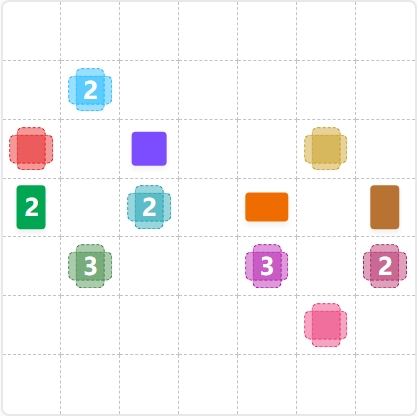
Answer
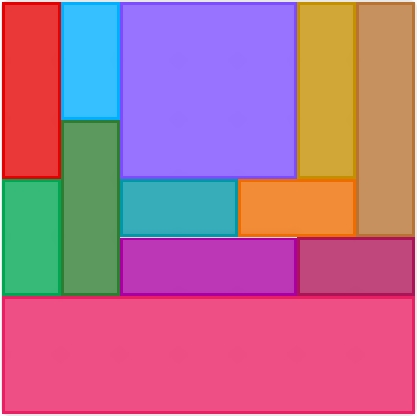
Patches #39 Expert Logic
Here is your strategic breakdown of today’s puzzle.
🧩 Deep Logic Analysis
To conquer Patches, you must understand the two languages the grid speaks: Numbers (exact area) and Shapes (solid = strict dimensions, dotted = wildcard proportions). Let’s deconstruct the chain reaction that solves #39.
Phase 1: The Absolute Anchors (Strict Solids) The best starting points are tokens with compound constraints—both a number and a solid shape.
- The Bright Green 2: As a solid tall rectangle with an area of 2, it is mathematically forced to be a 1x2 vertical block. Sitting near the left edge, its placement is rigid.
- The Right Wall: The Brown token is a solid tall rectangle on the far right. Without an area number, it could be any length, but it claims that right-hand edge, meaning it must be exactly 1 cell wide, forming a vertical pillar.
Phase 2: The Pink Foundation (The Perimeter Rule) Look at the vast, empty bottom-left corner of the grid. No other token is close enough to stretch into that corner and remain a valid rectangle without overlapping another clue. Because the dotted Pink token is the only patch that can legally bridge that gap, it is forced to stretch across the entire bottom two rows, becoming a massive 7x2 horizontal rectangle.
Phase 3: The Purple Square The Purple token is a solid square. By definition, it must occupy a perfect square area (1x1, 2x2, 3x3, etc.).
- A 2x2 would leave unfillable 1-cell gaps along the top edge.
- A 4x4 would collide with the Gold or Light Blue tokens.
- Therefore, expanding to exactly 3x3 is the only geometric fit, locking down the top-middle of the board.
Phase 4: The Snap-Together Finish With the Pink floor, Purple roof, and Brown right-wall established, the remaining board is heavily restricted. The Maroon 2 is forced horizontally (2x1) to stay out of Brown's vertical path. The Orange wide rectangle and Teal 2 lock horizontally into the tight space under Purple, neatly capping off the Magenta 3 beneath them. The left side effortlessly resolves as Red, Light Blue 2, and Olive Green 3 fill the remaining vertical channels.
🎓 Lessons Learned From Patches #39
- Respect the "Corner Void": Always scan the grid for isolated corners (like the bottom-left in this puzzle). Whichever token is geographically capable of reaching it will almost always define a massive section of your board.
- Prioritize Compound Clues: Make it a standard practice to seek out tokens that give you both an area and a rigid shape (like a tall 1x2 or wide 2x1). They offer immediate, undeniable placements that kickstart your momentum.
- The Perfect Square Constraint: Solid squares are highly restrictive. Because they scale geometrically (1, 4, 9, 16 cells), they are incredibly easy to "size up" mentally to see which boundary they will inevitably hit first.
💡 Trivia
- The Power of Primes: This grid is a 7x7 square, totaling 49 cells. Because 7 is a prime number, it is impossible to perfectly bisect the grid symmetrically with identical rectangular patches. This mathematical friction is exactly why edge shapes (like the massive 14-cell Pink base) are forced to take on such extreme dimensions.
- Square Law: In geometry, every square is technically a rectangle, but in the logic of Patches, the visual distinction is absolute law. A dotted token can be a square or a rectangle, but a solid square token rejects all other rectangular forms!
❓ FAQ
Why couldn't the bottom Pink shape just be a small 2x2 square?
If Pink were only 2x2, the bottom-left corner of the grid would become an unfillable dead zone. No other token is close enough to stretch into that corner while remaining a valid, unblocked rectangle.
How did we know the Purple shape had to be exactly 3x3?
The solid Purple token mandates a perfect square. A 2x2 would leave unfillable 1-cell gaps along the top edge, and a 4x4 would illegally overlap the Gold or Light Blue tokens. By elimination, exactly 3x3 fits the space perfectly.
What does the dotted border mean versus the solid fill?
A dotted border acts as a shape "wildcard," meaning the patch can be any rectangular proportion as long as it satisfies its area number. Solid shapes strictly dictate dimensions: wide patches must be horizontal, tall patches must be vertical, and squares must be perfectly symmetrical.