
LinkedIn Patches #41 Answer
Stuck on today’s grid? Get the LinkedIn Patches #41 solution and expert logic to maintain your streak instantly. Beyond the answer, explore our tactical hints to refine your spatial reasoning and master the game through daily practice.
Patches #41 Answer
Start
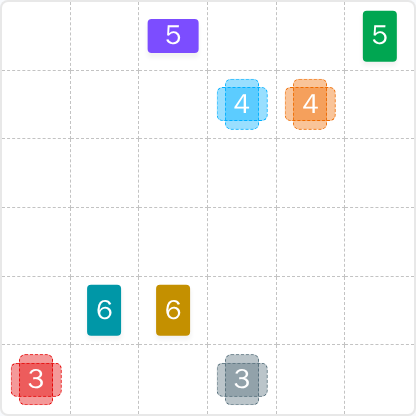
Answer
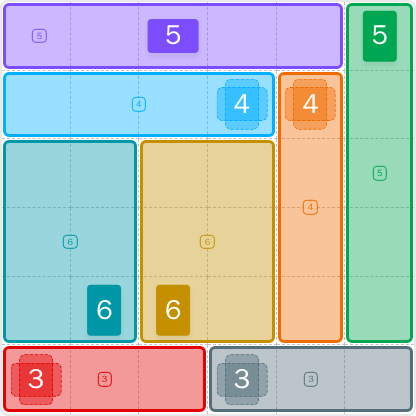
Patches #41 Expert Logic
🧩 Deep Logic Analysis
Solving Patches #41 requires a keen eye for how orientation icons dictate the flow of the grid. By following the constraints of the boundary, the solution reveals itself through a high-speed chain reaction.
1. The Corner Anchor (Green 5)
The Green 5 in the top-right corner features a vertical rectangle icon. Given its position, it must occupy the far-right column. Extending it downward to a shape is the only way to leave room for the top row to breathe.
2. The Top Row Squeeze (Purple 5)
With the top-right cell occupied by the Green 5, the Purple 5 (which has a horizontal icon) is forced into the remaining five cells of the first row. This perfectly completes the horizontal strip.
3. The Bottom Row Foundation
The Red 3 and Grey 3 at the bottom possess "flexible" icons, but because they sit on the bottom edge of a 6-wide grid, they must be horizontal blocks to avoid leaving "dead air" (empty cells) that no other shape could reach.
4. The Middle Vertical Blocks (Teal & Gold 6)
The Teal and Gold 6 clues both feature vertical rectangle icons. In the remaining space above the bottom row, two vertical rectangles fit side-by-side like puzzle pieces. This placement is forced because any horizontal orientation would collide with the side walls or the Green 5.
5. Finalizing the L-Gap (Blue & Orange 4)
This leaves a horizontal gap of 4 cells in row 2 and a vertical gap of 4 cells in column 5. The Blue 4 (horizontal) and Orange 4 (vertical) slide into these respective slots, sealing the grid.
🎓 Lessons Learned From Patches #41
- Trust the Iconography: The small glyphs behind the numbers aren't just decorative; they are your primary "cheat sheet" for orientation. A vertical icon in a tight horizontal corridor immediately narrows your options.
- The Law of Conservation: In a grid, you have 36 total cells. If your clues add up to 36 (as they do here: ), there is zero room for error or empty space. This makes the practice of "bounding" (checking if a shape fits without leaving gaps) essential for expert play.
- Edge Priming: Start with the longest shapes that touch the perimeter. The 5-unit and 6-unit shapes are much more restrictive than the 3-unit shapes, making them the logical starting point for any solve.
💡 Trivia
- Perfectly Packed: This specific grid is a "perfect tiling," meaning every single cell is occupied by a clue-defined shape with no remainder. This is mathematically satisfying and common in lower-difficulty Patches.
- The Magic of 6: The number 6 (seen in the Teal and Gold patches) is the first "perfect number" in mathematics, meaning its divisors (1, 2, and 3) add up to itself. In Patches, a 6 is uniquely versatile because it can be , , , or .
❓ FAQ
Why couldn't the Purple 5 be a vertical strip starting from the top?
The icon behind the Purple 5 is a horizontal rectangle. This strictly limits the shape's growth to the X-axis. Additionally, a vertical 5-strip in that column would have blocked the placement of the Teal 6 and Blue 4 shapes later in the logic chain.
Could the Red 3 have been a vertical tower?
Technically, the "plus" icon on the Red 3 allows for flexibility. However, if the Red 3 grew vertically, it would have created a "well" in the bottom-left corner that no other shape could fill. To ensure 100% grid coverage, it must lie flat.
How do I know the Teal 6 is instead of ?
The vertical icon indicates that the height must be greater than or equal to the width. While a is vertically oriented, the available space between the top Blue 4 and the bottom Red 3 is exactly 3 cells high, making the only viable configuration.