
LinkedIn Patches #46 Answer
Stuck on today’s grid? Get the LinkedIn Patches #46 solution and expert logic to maintain your streak instantly. Beyond the answer, explore our tactical hints to refine your spatial reasoning and master the game through daily practice.
Patches #46 Answer
Start
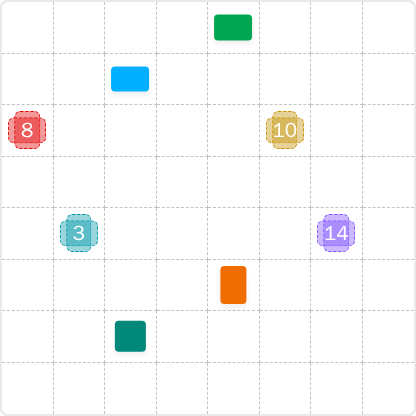
Answer
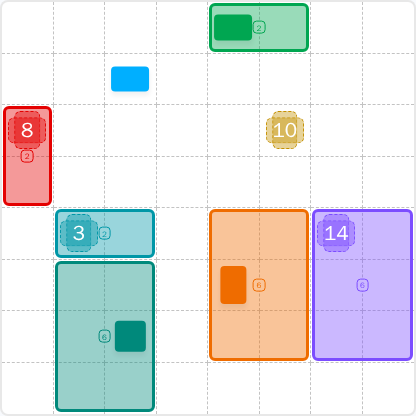
Patches #46 Expert Logic
Welcome to the strategic breakdown of LinkedIn Patches #46! If you’ve been scratching your head staring at these colorful floating blocks, you’re not alone. This specific grid is a masterclass in spatial reasoning and geometric deduction.
While Image 1 shows our daunting starting board, Image 2 provides a snapshot of an active "mid-solve" state, where the expanding shapes (and their current area counts displayed in small circles) hint at the beautiful chain reaction required to win.
Let’s dive into the logic, uncover the hidden chokepoints, and show how a little dedicated practice can turn you into a Patches grandmaster.
🧩 Deep Logic Analysis
To solve Patches #46, we must remember the golden rule of Shikaku-style grid games: every numbered block must be enclosed in a rectangle of that exact area, every blank block must form its own independent rectangle, and no space on the 8x8 grid can be left empty. Here is the step-by-step chain reaction to crack the board.
Step 1: The Purple Behemoth (The Starting Point) Always start with your most restrictive number. The Purple 14 at the bottom right is our massive anchor. Mathematically, a rectangle with an area of 14 can only be 1x14 or 2x7. Since our grid is only 8x8, a 1x14 strip is impossible. Therefore, Purple MUST be a 2x7 rectangle. Because it sits at column 7, it is forced to completely swallow columns 7 and 8, stretching almost the entire height of the board.
Step 2: The Yellow 10 Squeeze Next, we look at the Yellow 10. An area of 10 can be 1x10 (impossible) or 2x5. Could it be a 2x5 vertical rectangle? Look at the blank Green and Orange blocks. They sit directly above and below the Yellow 10's column. The gap between them is only 4 rows high—not enough space for a 5-tall shape! Therefore, Yellow 10 must be horizontal (5x2). With the Purple block acting as a brick wall on the right, Yellow is forced to stretch leftwards, locking down a massive 5x2 horizontal strip through the upper-middle of the grid.
Step 3: The Red 8 Pillar With Yellow 10 expanding horizontally across the board, it creates a roof over the left side. The Red 8 is now severely trapped. It needs an area of 8 (factors: 1x8, 2x4). Because the Yellow shape blocks column 2, Red cannot expand horizontally to be 2x4. The only surviving geometric possibility is for Red to be a 1x8 vertical pillar, perfectly filling the entire first column from top to bottom.
Step 4: Cyan 3 and the Blank Cascade Once the Red pillar and Yellow bridge are placed, the board is beautifully partitioned. The Cyan 3 is pinned between them. It must be a 1x3 or 3x1 shape, and its placement is now restricted to the small pockets left behind. The remaining blank blocks (Green, Blue, Teal, Orange) will organically snap into the remaining void spaces to ensure the 8x8 grid is fully patched with zero overlaps.
🎓 Lessons Learned From Patches #46
- The Prime Factorization Strategy: Large numbers with few logical factors (like 14) are your best friends. Always break down your clues into grid-viable dimensions first. If a number only has one playable shape (like the 2x7 for 14), lock it in immediately.
- Blank Anchors as Walls: Don't ignore the blank blocks! In this puzzle, the Green and Orange blocks acted as invisible walls that prevented the Yellow 10 from expanding vertically. Use unnumbered blocks to rule out paths for your numbered patches.
- The Perimeter Rule: Pieces on the absolute edge of the grid (like the Red 8) have 50% of their expansion options instantly removed by the game board's boundaries. Edge pieces combined with large area requirements often force straight lines.
💡 Trivia
- The 64-Square Constraint: An 8x8 grid contains exactly 64 squares. If you sum the required areas of the numbered blocks in this puzzle (8 + 10 + 3 + 14), you get 35. This means exactly 29 squares are left to be divided among the four unnumbered blank blocks!
- A Nod to Nikoli: The mechanics of "Patches" heavily borrow from a classic Japanese logic puzzle called Shikaku, invented by the puzzle publisher Nikoli in 1989. However, the addition of "blank" floating patches introduces a modern topological twist.
❓ FAQ
Why couldn't the Purple 14 be placed horizontally?
In an 8x8 grid, the maximum width of any shape is 8 squares. Since the factors of 14 are only 1x14 and 2x7, a horizontal placement would require a minimum width of 7. However, the Purple clue is located in column 7, meaning it only has 2 columns of horizontal space available. It is forced to go vertical.
What is the purpose of the blank colored blocks in the grid?
They are "wildcard" patches. While they don't have a specific target area dictated by a number, they must still form perfect, non-overlapping rectangles that absorb all the leftover empty squares once the numbered patches are completed.
What do the small numbers in the circles on Image 2 mean?
Image 2 shows a mid-game state. The small numbers in the circles (like the '2' on the Cyan patch or the '6' on the Orange patch) represent the current area of the shape as the player is dragging to expand it. The goal is to keep dragging until that current area matches the large clue number!