
LinkedIn Patches #47 Answer
Stuck on today’s grid? Get the LinkedIn Patches #47 solution and expert logic to maintain your streak instantly. Beyond the answer, explore our tactical hints to refine your spatial reasoning and master the game through daily practice.
Patches #47 Answer
Start
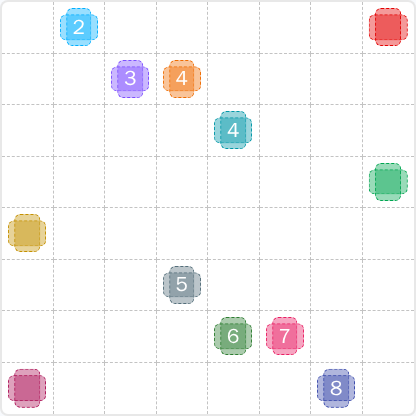
Answer
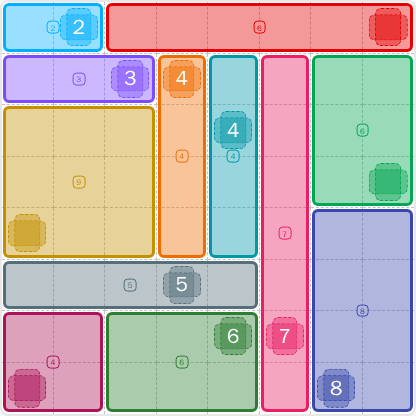
Patches #47 Expert Logic
Here is the deep-dive analysis for today’s LinkedIn Patches grid.
🧩 Deep Logic Analysis
Solving this grid required a masterful understanding of how structural "walls" isolate sections of the board. Here is the step-by-step deconstruction of the logical chain reaction:
1. The Prime Number Wall (The Starting Point) The most critical starting point in this grid is the Pink 7. Because 7 is a prime number, it cannot form a rectangle; it must be a 1x7 straight line. Since the clue is located near the bottom right (Row 7, Column 6), it cannot fit horizontally without colliding with the Dark Green 6 or Blue 8 clues. Therefore, it is forced to shoot vertically all the way to the top of the board. This brilliantly chops the rightmost two columns completely off from the rest of the board.
2. Boxing in the Right Flank With the Pink 1x7 wall in place, the right side is isolated. The Blue 8 in the bottom right corner is boxed in. A 1x8 won't fit, so it must form a 2x4 vertical block. That leaves exactly a 2x3 space above it on the right flank, perfectly accommodating the unmarked Light Green 6 patch. Finally, the unmarked Red patch at the top right is forced to slide horizontally across the very top row (1x6) to cap off the pink wall and the right flank.
3. The Bottom-Left Crush Moving to the bottom left, the unmarked Magenta patch is trapped in the corner. The Dark Grey 5 (another prime number forcing a 1x5 horizontal strip) acts as a ceiling, while the Dark Green 6 (a 2x3 horizontal block) pushes in from the right. This naturally restricts the Magenta space to a neat 2x2 square (area of 4).
4. The Final Puzzle Pieces With the bottom and right perimeters locked, the remaining space fills itself in through simple spatial deduction:
- The Light Blue 2 and Purple 3 are forced into horizontal strips at the top left.
- The Orange 4 and Teal 4 drop down as twin 1x4 vertical columns to dodge the massive void on the left.
- That remaining void perfectly swallows the unmarked Yellow clue, resulting in a highly satisfying 3x3 square (area of 9).
🎓 Lessons Learned From Patches #47
- The Prime Wall Strategy: Always target prime numbers (like 5, 7, or 11) first. Because they can only form 1-cell-wide strips, they act as massive architectural walls that divide the board into smaller, easily solvable sub-grids.
- Edge Confinement: Pay attention to clues hiding in the corners (like the Blue 8 or Light Blue 2). Corner pieces have the fewest degrees of freedom. By defining the edges first, you naturally dictate the shapes of the inner pieces.
- The Power of Repetition: It takes intentional practice to instantly recognize how an unmarked patch will behave based purely on the "shadow" of the shapes around it. Make a habit of mapping out your prime constraints before guessing on the larger squares.
💡 Trivia
- The Geometry of Primes: In grid-based logic puzzles, prime numbers are the only integers that guarantee a purely linear shape (1xN). Mathematically, because a prime has exactly two distinct positive divisors (1 and itself), it is impossible to arrange a prime number of square units into a true rectangle or square.
- The Magic Number 64: Standard LinkedIn Patches puzzles are built on an 8x8 grid. This means the sum of the areas of all the patches will always equal exactly 64. If you ever want to mathematically verify the sizes of your unmarked patches, simply subtract your known clues from 64!
❓ FAQ
Why couldn't the Pink 7 patch go horizontally?
Because the Pink 7 clue is located on the 6th column of the 7th row. To stretch horizontally 7 spaces, it would need to cross through the space occupied by either the Blue 8 clue to its right or the Dark Green 6 clue to its left. Logic dictates it must be a vertical strip.
How do you deduce the size of the unmarked Yellow patch?
By using the process of elimination. Once you lock in the top horizontal strips (Light Blue 2, Purple 3), the bottom horizontal boundaries (Dark Grey 5), and the vertical columns to the right (Orange 4, Teal 4), the Yellow clue is perfectly boxed into a 3x3 void. 3 multiplied by 3 gives it an area of 9.
Why did the Orange 4 and Teal 4 have to be vertical?
If either the Orange or Teal 4 tried to lay horizontally, they would have intersected with the Yellow patch's territory or the Pink 7 wall. Their placement in adjacent columns naturally forces them to cascade downward like Tetris blocks to fill the remaining structural gaps.