
LinkedIn Patches #48 Answer
Stuck on today’s grid? Get the LinkedIn Patches #48 solution and expert logic to maintain your streak instantly. Beyond the answer, explore our tactical hints to refine your spatial reasoning and master the game through daily practice.
Patches #48 Answer
Start
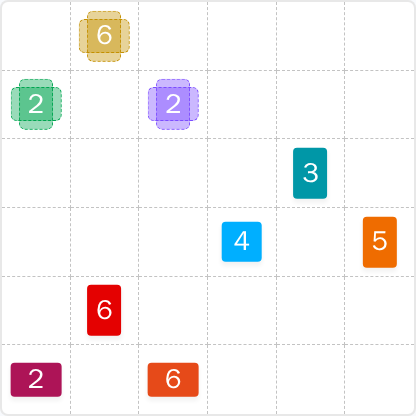
Answer
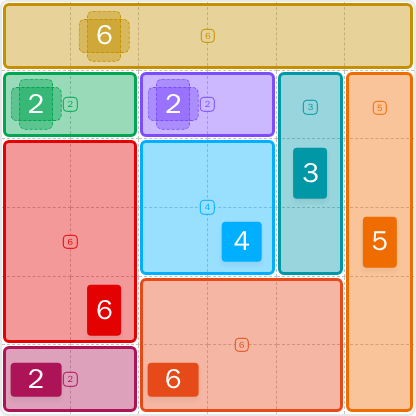
Patches #48 Expert Logic
Welcome back, puzzle strategists! If you’ve been scratching your head over today’s grid, you are in the right place. LinkedIn Patches #48 is a masterclass in edge constraints and prime number logic.
Let's dissect the board, uncover the hidden chain reactions, and elevate your spatial reasoning game.
🧩 Deep Logic Analysis
To conquer this 6x6 grid, we need to find the most restricted shapes and let them dictate the rest of the board. Here is the step-by-step deconstruction of Patches #48:
- Step 1: The Yellow 6 and the Top Row Monopoly The Yellow 6 sits at R1C2. Because of the Green 2 just below it (R2C1), the Yellow 6 cannot expand downward into a 2x3 or 3x2 block without causing an overlap. This forces the Yellow 6 to stretch horizontally into a 1x6 strip, completely monopolizing the top row.
- Step 2: The Orange 5 Edge Constraint With Row 1 fully occupied, look at the Orange 5 on the right edge. Since 5 is a prime number, it must be a 1x5 straight line. Bounded by the top row, it has exactly one valid placement: a vertical 1x5 strip dropping perfectly from R2C6 down to R6C6.
- Step 3: The Teal 3 and Rust 6 Domino Effect The Teal 3 is also prime. Bounded by the Orange 5 on its right and the Blue 4 on its left, it cannot stretch horizontally. It must drop into a 1x3 vertical strip. This leaves the bottom right area restricted, forcing the Rust 6 into a 3-wide by 2-tall horizontal block spanning the bottom edge.
- Step 4: Mopping up the Left Flank With the right and bottom right filled, the bottom-left Maroon 2 is forced into a 1x2 horizontal strip. This creates a perfect 2-wide by 3-tall pocket for the Red 6. Finally, the Blue 4 settles naturally into a 2x2 square, leaving exactly enough room for the Green 2 and Purple 2 to form horizontal 1x2 rectangles.
🎓 Lessons Learned From Patches #48
- The Prime Number Strategy: Always target prime numbers (like 2, 3, and 5) first. Because primes cannot be factored into smaller grids (like 2x2 or 2x3), they must be 1-by-X straight lines. They act as excellent "grid slicers" that separate the board into manageable chunks.
- The Perimeter Rule: Corners and edges are your best friends. Shapes placed on the perimeter have 50% fewer expansion options than shapes in the center, making their placement highly predictable.
- The Power of Deduction: As with any high-level spatial reasoning challenge, regular practice is the true differentiator. The more you train your brain to spot "forced moves" early, the less guessing you'll have to do on complex boards.
💡 Trivia
- Perfect Packaging: Did you know that the sum of all the numbers in this specific puzzle (6+2+2+3+4+5+6+2+6) equals exactly 36? In a 6x6 grid, this means there is zero "dead space." Every single cell is part of the mathematical equation!
- The Geometry of 6: The number 6 is a composite number with a high degree of spatial flexibility. Unlike primes, a patch of 6 can take four distinct geometric shapes in this game: 1x6, 6x1, 2x3, and 3x2.
❓ FAQ
Why couldn't the Yellow 6 be a 2x3 block in the top left?
If the Yellow 6 formed a 2x3 block (spanning two rows and three columns), it would swallow the cell containing the Green 2. Since rules dictate each patch can only contain its own designated number, the Yellow 6 was forced into a 1x6 horizontal strip to avoid a collision.
How do we know the Teal 3 is vertical instead of horizontal?
The Teal 3 sits directly next to the Blue 4. If the Teal 3 attempted to stretch horizontally into a 3x1 strip, it would bleed into the territory required by the Blue 4 to form its necessary 4-cell area.
Why is the Orange 5 forced to the bottom right edge?
Because 5 is a prime number, it requires a 5-cell straight line. Once the Yellow 6 claimed the entire top row, the right-most column only had exactly 5 empty cells remaining (Rows 2 through 6). The Orange 5 had no choice but to fill that exact vertical pocket.